Wednesday, December 31, 2014

Out with the Old, In with the New!


Picture from clip art

I, for one, do not believe in resolutions. They are easy – maybe too easy – to make and just as easy to break. Like promises or good intentions (though having intentions is a good thing), it is easy to fall through the cracks on them.

In fact, synonyms for resolutions include words such as intention, resolve, commitment, pledge and promise...pretty strong words to say the least, don’t you think? The definition of resolution is "a firm decision to do or not to do something."

Regardless of the strength of these words, unless we have determination, discipline, and conviction at minimum, resolutions may not be met. And why bother setting up for failure, especially at the beginning of a fresh, new year?

A goal on the other hand is "the object of a person's ambition or effort; an aim or desired result." Synonyms for goal include objective, aim, target, intent as well as intention, and purpose amongst others.

I actually prefer this though I have heard that "target" is an even better word than "goal" as a goal is finite whereas a target can be changed as in "a moving target."

After a number of years of setting goals and/or resolutions and even writing them down at times, I decided to stop this practice. I was willing to dismiss what no longer served me. I strongly suggest you do the same: Stop it. Throw it out if need be. After all, if it doesn't work, why keep doing it?


Brief comedy sketch video featuring Bob Newhart regarding "STOP IT!"

As Albert Einstein smartly remarked insanity is "doing the same thing over and over again and expecting different results" or as he also similarly stated, "We cannot solve our problems with the same thinking we used when we created them.” It starts in the mind with action being the final result.

Thus, I changed my strategy. Instead, I set a focus or theme for the year; I find this more powerful a practice. Sometimes it comes in the form of one word, sometimes two different words such as "peace" and "joy" for example.

I had come across one or two other bloggers recently whom I understand do similarly - hmmm, reminds me of the 100th monkey phenomenon! (see ) - and I liked a word chosen as their focus for next year; however, even though I thought I would remember it, I didn't write it down and have since forgotten it!

I had recently pondered a word along the lines of pursuing my interests or the like. However, I discovered this past year that the word "passion" has a negative connotation as in "suffering."

Thus, keeping all the above in mind, do you perhaps now understand why I chose the word "transformation" as my focus or theme for 2015? That's the word that came to me spontaneously, i.e., intuitively.

Let’s see what happens, shall we? Stay tuned… ;)

Do you set resolutions, goals, or intentions? Any or all of the above? Which one(s) do you find work best for you? How do they work for you in terms of a focus for a new year?
HAPPY NEW YEAR! Happy 2015!! :)

P.S. I was going to feature a picture of a dart pointed in the middle of a dart board as that symbolized 'target' (read more above). However, since soccer is such a universal sport, I decided to depict a soccer goal instead! ;)

Linked to UltraBlog, Blog-A-Rhythm, and WordOfTheYear.


Friday, December 26, 2014

Boxing Day and Kwanzaa


Due to various factors today, I am blogging primarily from wikipedia. (Sorry.)

Picture from Clipart

Boxing Day is not today what it was originally intended to be. According to http://www.en.wikipedia.org/wiki/Boxing_Day:
Boxing Day is a holiday traditionally celebrated the day following Christmas Day, when servants and tradesmen would receive gifts, known as a "Christmas box", from their bosses or employers, in the United Kingdom, Barbados, Canada, Hong Kong, Australia, New Zealand, Kenya, South Africa, Guyana, Trinidad and Tobago, Jamaica and other former British colonies. The employers would give each servant a box to take home containing gifts, bonuses and sometimes leftover food.

In South Africa, Boxing Day was renamed Day of Goodwill in 1994. Due to the Roman Catholic Church's liturgical calendar, the day is known as St. Stephen's Day to Catholics, and in Italy, Finland, and Alsace and Moselle in France. It is also known as both St. Stephen's Day and the Day of the Wren or Wren's Day in Ireland. In some European countries, including notably Germany, Poland, the Netherlands and those in Scandinavia, 26 December is celebrated as the Second Christmas Day.

In the UK, Canada, and some states of Australia, Boxing Day is primarily known as a shopping holiday, much like Black Friday (the day after Thanksgiving) in the US. Boxing Day sales are common in Canada. It is a time where shops have sales, often with dramatic price reductions.

Picture from clipart

Many retailers open very early (typically 5 am or even earlier) and offer doorbuster deals and loss leaders to draw people to their stores. It is not uncommon for long queues to form early in the morning of 26 December, hours before the opening of shops holding the big sales, especially at big-box consumer electronics retailers. Many stores have a limited quantity of big draw or deeply discounted items. Because of the shoulder-to-shoulder crowds, many choose to stay home and avoid the hectic shopping experience.

The local media often cover the event, mentioning how early the shoppers began queuing up, providing video of shoppers queuing and later leaving with their purchased items. Many retailers have implemented practices aimed at managing large numbers of shoppers. They may limit entrances, restrict the number of patrons in a store at a time, provide tickets to people at the head of the queue to guarantee them a hot ticket item or canvass queued-up shoppers to inform them of inventory limitations.

In recent years, retailers have expanded deals to "Boxing Week". While Boxing Day is 26 December, many retailers will run the sales for several days before or after 26 December, often up to New Year's Eve. Notably, in the recession of late 2008, a record number of retailers were holding early promotions due to a weak economy Canada. Boxing Day has often been compared with the American Super Saturday, the Saturday before Christmas.

In some areas of Canada, particularly in Atlantic Canada and parts of Northern Ontario, most retailers are prohibited from opening on Boxing Day, either by provincial law or municipal bylaw, or instead by informal agreement among major retailers to provide a day of relaxation following Christmas Day. In these areas, sales otherwise scheduled for 26 December are moved to the 27th.
I personally like the idea of one day of relaxation after Christmas as I find it makes most sense and is practical.

Today is also Kwanzaa honouring those of African heritage in African-American culture . It was developed by Maulana Karenga in the mid 1960's as a week-long celebration that begins December 26th and ends January 1st with the giving of gifts and a feast.

Check this video for a brief history on Kwanzaa: http://cdn.history.com/sites/2/2013/11/kwanzaa-candles-candleholder-H.jpeg

According to http://www.en.wikipedia.org/wiki/Kwanzaa:
Each of the seven days of Kwanzaa is dedicated to one of the following principles, as follows:

Umoja (Unity): To strive for and to maintain unity in the family, community, nation, and race.
Kujichagulia (Self-Determination): To define ourselves, name ourselves, create for ourselves, and speak for ourselves.
Ujima (Collective Work and Responsibility): To build and maintain our community together and make our brothers' and sisters' problems our problems, and to solve them together.
Ujamaa (Cooperative Economics): To build and maintain our own stores, shops, and other businesses and to profit from them together.
Nia (Purpose): To make our collective vocation the building and developing of our community in order to restore our people to their traditional greatness.
Kuumba (Creativity): To do always as much as we can, in the way we can, in order to leave our community more beautiful and beneficial than we inherited it.
Imani (Faith): To believe with all our hearts in our people, our parents, our teachers, our leaders, and the righteousness and victory of our struggle.

Photo from wikipedia

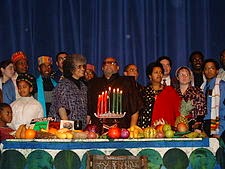
Kwanzaa symbols include a decorative mat (Mkeka) on which other symbols are placed: corn (Muhindi) and other crops, a candle holder kinara with seven candles (Mishumaa Saba), a communal cup for pouring libation (Kikombe cha Umoja), gifts (Zawadi), a poster of the seven principles, and a black, red, and green flag. The symbols were designed to convey the seven principles.

Families celebrating Kwanzaa decorate their households with objects of art, colorful African cloth such as kente, especially the wearing of kaftans by women, and fresh fruits that represent African idealism. It is customary to include children in Kwanzaa ceremonies and to give respect and gratitude to ancestors. Libations are shared, generally with a common chalice, Kikombe cha Umoja, passed around to all celebrants. Non-African Americans also celebrate Kwanzaa. The holiday greeting is "Joyous Kwanzaa".

A Kwanzaa ceremony may include drumming and musical selections, libations, a reading of the African Pledge and the Principles of Blackness, reflection on the Pan-African colors, a discussion of the African principle of the day or a chapter in African history, a candle-lighting ritual, artistic performance, and, finally, a feast (karamu). The greeting for each day of Kwanzaa is Habari Gani? which is Swahili for "What's the News?"

At first, observers of Kwanzaa avoided the mixing of the holiday or its symbols, values, and practice with other holidays, as doing so would violate the principle of kujichagulia (self-determination) and thus violate the integrity of the holiday, which is partially intended as a reclamation of important African values.

Today, many African American families celebrate Kwanzaa along with Christmas and New Year's. Frequently, both Christmas trees and kinaras, the traditional candle holder symbolic of African American roots, share space in Kwanzaa-celebrating households. For people who celebrate both holidays, Kwanzaa is an opportunity to incorporate elements of their particular ethnic heritage into holiday observances and celebrations of Christmas.
Picture from wikipedia

Maya Angelou, American author, poet, dancer, actress and singer...) was the narrator in The Black Candle, a documentary about Kwanzaa (http://www.en.wikipedia.org/wiki/The_Black_Candle).

What essence of Boxing Day and/or Kwanzaa do you celebrate? If not, do you celebrate any of the other days mentioned?

Saturday, December 20, 2014

Winter: Solstice and Harp


First snow 2014

We associate winter possibly with snow and Christmas, though many people throughout the world also celebrate the winter solstice. I certainly have.

What is the solstice you ask? Though commonly referred to as winter solstice, at least in the northern hemisphere, it is known for the shortest day of the year and the longest night; it is opposite in the southern hemisphere where they experience the longest day and the shortest night as they are experiencing summer solstice! (

Did you know that the solstice is actually not the whole day, but actually at a specific point in time? For us here in Vancouver, British Columbia, it was 3:03 pm (or 1503 hrs) when "old man winter" finally arrived.

For the past approximately 15 years, I have participated and volunteered at a community event marking the winter solstice. Jerry DesVoignes, chantmaster leads community gatherings of chants and songs, including those that mark the shortest day of the year and the return of the light.

I actually got hooked (for lack of a better term) when I attend my first such event the same year, 1997, when both Princess Diana and Mother Teresa died: two bright lights snuffed out within a week apart.

It was a fun and also a magical experience due to a ritual - Aarti ( - and rose petals showered upon people, usually their heads. (You can see why I got hooked.) ;)

Unfortunately at this time, I do not have any pictures to show of the beautiful altar that is created with candles, flowers, and symbols. However, you can get a taste of one of Jerry's chants here below at about the 5:25 time mark...you can hear some of his vocal range - I believe he has an eight-octave range - as he starts to tone at the 4:15 time mark:


Do you celebrate the solstice and if so, how?

Backdrop for Part 2 of Winter Harp concert
This past week I attended a concert by Winter Harp, a group of musicians/performers who play various harps. flutes, and other ancient instruments. Here is a video of some of them playing "O Come, O Come Emmanuel."

Or how about this one, where some other members play, "Girl in the Red Skirt" a flamenco tune.


Have you seen any Christmas concerts this year, and if so, which ones or what kinds?

Sunday, December 14, 2014

Ode to Joy/Joyful Joyful


Youtube video

The word that came to me immediately after listening to this video was simply "WOW!"

'Ode to Joy' also known as 'Beethoven's Symphony No. 9', was written by German composer Ludwig Van Beethoven in his later years when he was mostly deaf.

Ode by the way means, "a lyric poem in the form of an address to a particular subject, often elevated in style or manner and written in varied or irregular meter" or "a poem meant to be sung."

In fact, it was originally a poem written by Friedrich Schiller who was a German poet, playwright, and historian, though it was adapted later by Beethoven http://www.en.wikipedia.org/wiki/Ode_to_Joy

Here is a bit of background to this song: http://www.en.wikipedia.org/wiki/Symphony_No._9_%28Beethoven%29

On the 130th anniversary of the founding of Banco Sabadell, a number of people wanted to pay homage to Sabadell, a city in Spain with a flash mob consisting of 100 people from Vallès Symphony Orchestra, the Lieder, Amics de l'Òpera, and Coral Belles Arts choirs (as shown in the video above).

Here is a version that sticks out in my mind from years ago, from the movie Sister Act 2, with Whoopi Goldberg as one of the main actors:

.
This musical piece is seemingly popular during the Christmas season, though with differing variations of lyrics, one of which is as follows: http://www.lyricsfreak.com/s/soundtracks/ode+to+joy_10220943.html

byoV (short for 'bring your own voice'), the community choir that I sang with sang a somewhat similar version for our recent Christmas concert. It was a lot of fun for us choir members as well as the audience who heard us. How can it not be when you add a little funk, soul, and rap into it? Ok, that's my interpretation anyway! ;)


There is nothing like music bringing people together now is there?

What do you most enjoy about the videos above?